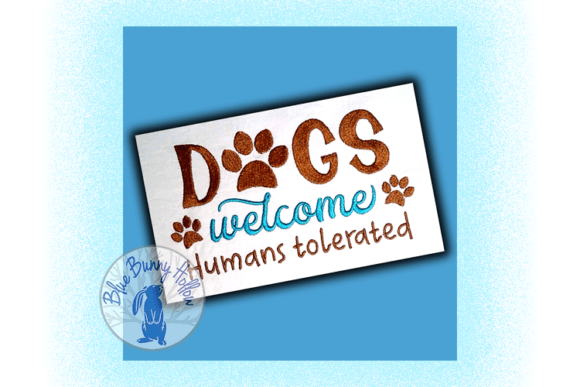
Dogs Welcome Humans Tolerated
A Craft Fair Designer’s Real-World Review Before Booth Day
As an embroidery designer who’s packed, stitched, and sold at over 70 craft fairs and handmade markets, I approach every new design like a booth inventory decision—not just “Is it cute?” but “Will it stop someone mid-aisle? Will it stitch cleanly on six fabric types before noon? Will it photograph well for my Etsy listing *and* hold up under fluorescent market lighting?” That’s why Dogs Welcome Humans Tolerated caught my eye immediately—and why I’m sharing this unfiltered pre-production review with fellow small shop owners, Etsy sellers, and creative entrepreneurs.
First Impression: Playful, Punchy, and Instantly Relatable
Dogs Welcome Humans Tolerated lands as bold, humorous, and warmly irreverent—not rustic, not minimalist, not elegant—but delightfully human. It reads like a dog lover’s inside joke made tangible. At a glance, it feels modern enough for a boutique apron but cozy enough for a farmhouse tea towel. There’s no floral scrollwork or delicate script to soften the message; instead, the phrasing itself carries the charm. That’s gold for craft fair buyers scanning dozens of booths in under three minutes.
Where It Shines (and Where It Needs Care)
This machine embroidery design thrives where personality meets practicality:
- Tote bag design: Perfect centered on canvas or denim—large enough to read from six feet away, with rhythm and spacing that balances visual weight.
- Apron embroidery: Ideal above the pocket or across the chest panel. The phrase’s horizontal flow suits apron silhouettes without crowding seams or pockets.
- Tea towel embroidery: Works beautifully on the lower third of a linen or cotton towel—especially when paired with a simple border or corner paw print accent.
- Embroidered patch: Highly effective as a sew-on or iron-on patch for jackets, backpacks, or market bags. Its clear hierarchy (Dogs first, Humans second) makes it legible even at 3” wide.
- Pillow cover & small pouch: A strong focal point—just ensure lettering remains >5mm tall to retain clarity on textured fabrics.
It’s less ideal for curved surfaces like caps unless digitized specifically for that application—standard flat-hooped files often distort on crown curves. And while it’s charming on light fabric, Dogs Welcome Humans Tolerated will need high-contrast thread colors (e.g., navy on cream, charcoal on oat) to pop on dark or heavily textured towels.
Production Reality Check: Stitch Density, Readability & Batch Flow
This isn’t a low-stitch-count filler design—it’s a statement. Expect moderate-to-high stitch density, especially if the “Dogs” and “Humans” are rendered with playful weight contrast. That means:
- Test on scrap fabric first—especially with terry cloth, waffle weave, or thick canvas. Adjust stabilizer type (cutaway for stability, tear-away for lighter cottons).
- Check letter spacing—tight kerning may blur on dense weaves. If your embroidery file has condensed fonts, consider slight tracking expansion for better legibility.
- Hoop size matters. Verify the full phrase fits comfortably within your most-used hoop (e.g., 4x4" or 5x7") without re-hooping mid-stitch—a major time-saver during batch production.
- Small lettering is its only vulnerability. “Tolerated” is the quietest word—and the easiest to lose on textured surfaces or at smaller scales. If offering multiple sizes, keep the smallest viable version at ≥3.5” wide.
Why It Converts at Market Stalls & Online
In person, Dogs Welcome Humans Tolerated creates instant connection. Dog lovers pause, smile, snap photos, and often say aloud, “That’s *so* me.” That verbal engagement is booth magic—it invites conversation, builds rapport, and increases dwell time. On Etsy or social listings, it performs strongly in search for “dog lover gift,” “funny embroidery,” and “handmade pet product”—especially when paired with authentic printable mockups showing real tote bags, aprons, and tea towels.
It also reinforces handmade quality: the humor feels intentional, not mass-produced. Buyers associate that tone with thoughtful curation—not generic clip art. When displayed alongside complementary designs (a simple paw, a bone icon, or “Dog Mom Life”), it strengthens brand consistency across your small shop product line.
Designer Notes You Can’t Skip
Before cutting your first production run, do these six things:
- Run a test stitch on each target fabric—canvas, linen, terry, denim, and cotton twill—to assess thread lay, puckering, and clarity.
- Compare thread colors against actual fabric swatches—not screen previews. What looks crisp on monitor may vanish on oat-colored canvas.
- Review spacing between words. Uneven gaps undermine readability at arm’s length.
- Confirm your digital embroidery file includes commercial licensing—or contact the creator directly. Never assume personal-use-only files are safe for resale as finished product.
- Create at least one physical mockup (not just a digital preview) to evaluate scale, contrast, and tactile appeal.
- Ask a non-dog-person friend to read it aloud from 6 feet away. If they hesitate or misread “Tolerated,” adjust sizing or spacing.
The Bottom Line for Creative Entrepreneurs
Dogs Welcome Humans Tolerated isn’t just another embroidery file—it’s a conversation starter, a branding anchor, and a proven craft fair magnet. It balances wit and warmth, stands out without shouting, and translates seamlessly from tea towel to tote to embroidered patch. For Etsy sellers building a niche around pet-loving lifestyles, for boutique makers curating joyful handmade products, and for embroidery business owners seeking repeatable, high-engagement designs—it delivers.
Just remember: its strength lies in clarity, contrast, and context. Stitch it thoughtfully, display it boldly, and let the dogs (and their humans) do the rest.