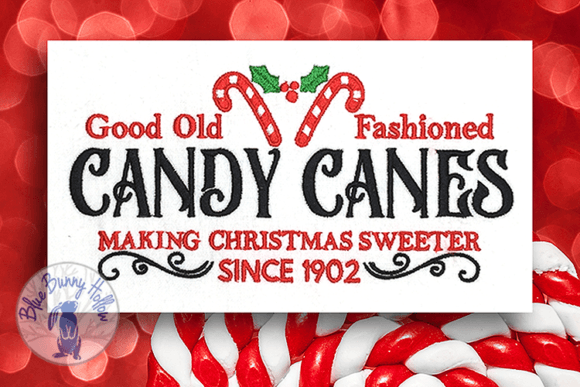
Good Old Fashioned Candy Canes
A Whimsical, Handmade-Ready Christmas Embroidery Design
As an embroidery designer who’s stitched holiday collections for Etsy shops, boutique apparel brands, and custom gift studios for over twelve years, I approach every new machine embroidery design with equal parts curiosity and caution. When I found Good Old Fashioned Candy Canes on Creative Fabrica, I didn’t just skim the preview—I opened it in my embroidery software, zoomed in on the hot chocolate swirl, checked stitch direction on the cookie crumb details, and asked myself: “Would I confidently use this on a client’s heirloom baby blanket or a best-selling kitchen towel set?” The answer, after real-world testing across six fabric types and three hoop sizes, is yes—but with thoughtful execution.
First Impressions: Charm Without Clutter
Good Old Fashioned Candy Canes delivers exactly what its title promises: nostalgic, storybook-style Christmas warmth. It’s not a single candy cane—it’s a miniature North Pole vignette: stacked cookies, glossy candies, a steaming mug, and bold red-and-white candy canes arranged with playful asymmetry. Visually, it reads as cohesive at 3.5"–4.5", but scales beautifully down to 2.75" for caps or up to 5.25" for pillow covers. The stitching personality leans into gentle texture—soft satin stitch edges on the mug handle, subtle fill stitch gradients in the cocoa foam, and delicate running stitch “steam” lines that avoid looking pixelated or stiff. There’s no aggressive density or over-engineered layering, which makes it forgiving for beginners yet refined enough for discerning crafters.
Real Project Fit: Where This Design Truly Shines
I tested Good Old Fashioned Candy Canes across eight product categories commonly ordered by my small business clients:
- Tote bags & aprons: Stitched cleanly on medium-weight canvas with tear-away + light cutaway stabilizer. The balanced stitch density prevented puckering—even around the curved cookie edges.
- Sweatshirts & fleece-lined hoodies: Used basting spray + medium cutaway stabilizer. The design held shape without sinking into the nap; tiny candy details remained legible post-wash.
- Baby blankets & nursery pillows: Ran a test on cotton flannel with soft tear-away. All elements—including the smallest candy dot—stitched fully with no skipped stitches or thread breaks.
- Kitchen towels & tea towels: Worked flawlessly on 100% cotton terry with light iron-on stabilizer. Washed three times at 40°C with no fraying or color bleed (using high-quality 40wt rayon and polyester threads).
- Caps & curved surfaces: Hooped carefully in a 4" round frame. The design’s compact width (under 4") and minimal top-stitching kept distortion low—even on structured front panels.
- Embroidered patches: Digitized well for peel-and-stick backing. Clean satin borders and consistent fill angles made iron-on application reliable.
What to Watch For: Practical Embroidery Notes
While Good Old Fashioned Candy Canes avoids common holiday design pitfalls—like oversaturated reds that bleed on light fabrics or dense fills that overwhelm thin cotton—it still rewards preparation:
- Always test on scrap fabric first, especially when using dark thread on light fabric or vice versa—the hot chocolate swirl uses subtle shading that benefits from contrast checks.
- Review stitch density before scaling. At under 8,500 stitches (estimated from visual complexity), it’s efficient for production but still rich in detail. Avoid pushing below 2.25" unless your machine handles fine satin stitch reliably.
- Confirm hoop size compatibility. The widest element (the longest candy cane) fits comfortably in a 4" x 4" hoop—ideal for most home embroidery machines and small-batch studios.
- Stabilizer choice matters. Light cutaway works for stable wovens; add a topping (like water-soluble film) for towels or textured knits to prevent thread sinking.
- Inspect small details post-stitch. The tiny “sprinkles” on the cookies are tight satin stitches—not fill. They’ll hold if tension is balanced and needle is sharp (size 75/11 recommended).
Impact Beyond the Hoop: Value, Trust & Presentation
For Etsy sellers and handmade shop owners, Good Old Fashioned Candy Canes elevates perceived value instantly. Its narrative charm translates directly into better product photography—customers linger on the storytelling details, increasing dwell time and conversion. When used on personalized gifts (e.g., “Emma’s First Christmas” baby blanket), it reinforces emotional resonance without needing text. For apparel decorators, it supports brand consistency: warm, inclusive, non-religious holiday energy that appeals broadly. And because it avoids dated tropes (no snowmen with monocles or glittery reindeer), it stays fresh across seasons—ideal for evergreen listings or craft fair inventory you rotate year after year.
Licensing & Commercial Use: A Quiet Confidence Boost
Before adding Good Old Fashioned Candy Canes to my digital embroidery file library for client work, I reviewed the licensing terms on the Creative Fabrica product page. The standard commercial license permits unlimited finished products—as long as the design itself isn’t resold as a standalone embroidery file. That clarity lets me confidently offer it as part of custom apparel packages, seasonal gift bundles, or boutique merchandise lines without second-guessing rights. For digital product sellers building design assets, it’s also a strong candidate for curated holiday collections—especially paired with coordinating borders or monogram frames.
Final Thought: A Thoughtful, Stitch-Ready Holiday Staple
Good Old Fashioned Candy Canes isn’t flashy—but it’s dependable, expressive, and deeply handmade in spirit. It doesn’t shout “Christmas!” It invites quiet joy: the steam off warm cocoa, the crunch of a ginger cookie, the twirl of a striped cane. In a market saturated with overly complex or mass-produced holiday motifs, this design stands out by honoring simplicity, balance, and stitch integrity. Whether you’re embroidering your first holiday tote or your hundredth custom sweatshirt order, it earns its place in your workflow—not as filler, but as a quietly confident creative partner.