Detailed Flowers: A Business-Ready Embroidery Design Review
First Impression: Elegant, Vibrant, and Professionally Handcrafted
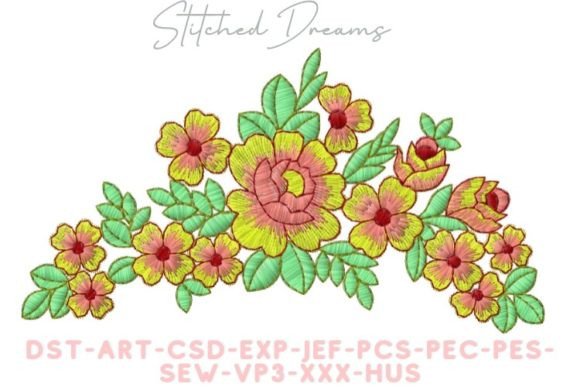
As an embroidery designer who’s developed hundreds of commercial designs for small businesses, my first reaction to Detailed Flowers is immediate confidence. The title alone signals intention—not just floral decoration, but precision, care, and visual storytelling. From the description—“a vibrant bouquet of exquisitely detailed flowers, each petal delicately textured and radiating with vivid colors”—I sense a design that balances artistry with execution discipline. It reads as elegant yet approachable, premium without feeling stiff, and handmade without sacrificing polish. That duality is gold for brands like local florists, artisan bakeries, boutique studios, or wellness studios seeking embroidered patches, aprons, or tote bag accents that reflect both authenticity and professionalism.
Real-World Performance Across Small Business Merchandise
Detailed Flowers shines where many floral machine embroidery designs falter: in context. On a woven embroidered patch sewn onto a café apron? It conveys warmth and attention to detail—reinforcing a brand that values craft. As a chest accent on staff uniforms for a botanical skincare line? Its graceful stems and layered petals suggest natural sophistication without overwhelming the garment. For cap embroidery on curved fronts, the design’s organic flow adapts well—if digitized with appropriate underlay and reduced density in tight curves. As a tote bag design, it anchors the piece with visual weight and charm, especially when paired with minimalist typography or a small business logo nearby.
It also excels in versatile applications: sleeve details on work shirts, branded packaging accents (think stitched tags on gift boxes), event merch for farmers’ markets or craft fairs, and Etsy branding for handmade product lines. Because it’s rooted in realism—not abstraction—it builds instant recognition and emotional resonance. Customers don’t just see “flowers”; they see care, growth, and intention—qualities small businesses actively cultivate in their brand identity.
Where to Use Detailed Flowers Thoughtfully
Like any high-detail digital embroidery file, Detailed Flowers demands thoughtful placement. Avoid shrinking it below 2.5 inches wide for embroidered patches—petal texture and stem intricacy risk blurring or stitching distortion. Cap fronts and curved surfaces require careful digitizing review: check how tightly spaced elements (like clustered stamens or overlapping leaves) hold up under tension. On dark uniforms or textured fabrics—denim, canvas, or heavy twill—verify thread color contrast; vivid hues may mute unless paired with bright, high-sheen polyester threads.
High stitch density is implied by “delicately textured” petals and “intricate” stems—so test wash durability on finished product samples. Frequent laundering can soften fine details over time, especially on cotton-rich blends. If your small business merch includes reusable items (tote bags, aprons, tea towels), consider simplifying one version of Detailed Flowers for longevity—perhaps a clean-line variant with fewer fill layers—while keeping the full design for premium packaging or limited-edition items.
Strengthening Brand Identity and Customer Trust
Floral motifs often walk a fine line between generic and distinctive. Detailed Flowers avoids cliché by emphasizing specificity—individual petal shapes, directional stem flow, and intentional color layering. That specificity translates directly into brand trust. When customers see this design on a bakery’s custom apparel or a pet brand’s embroidered bandana, they register consistency, craftsmanship, and investment—not just decoration. It elevates perceived product value and supports visual consistency across touchpoints: from physical merchandise to printable mockups used in social media or client proposals.
For Etsy sellers and handmade brands, Detailed Flowers reinforces the “human-made” story. Unlike clipart or AI-generated patterns, its described texture and vibrancy signal skilled digitizing—and by extension, skilled production. That perception increases buyer engagement and justifies premium pricing on embroidered goods.
Practical Designer Notes Before You Stitch
Before committing to production, run these checks:
- Test in black and white first—to assess contrast, balance, and silhouette clarity without color distraction.
- Check minimum viable size—scale down to your smallest intended use (e.g., 2-inch patch) and verify readability of key features.
- Review thread color contrast—especially against common uniform fabrics (navy, charcoal, oatmeal). Simulate thread sheen and lighting conditions.
- Inspect spacing and underlay—tight petal clusters need proper underlay to prevent fabric puckering on lightweight materials.
- Confirm hoop size compatibility—ensure the design fits standard hoops used in your shop or production partner’s workflow.
- Test on real fabric—not just stabilizer swatches. Cotton poplin, twill, and canvas behave differently under dense stitching.
- Use appropriate stabilizer—cutaway for stretchy or unstable fabrics; tearaway for stable wovens; mesh for caps.
- Create a printable mockup for client approval—show Detailed Flowers alongside logo, tagline, and garment type to confirm visual harmony.
- Compare beside other design assets—does it complement your current embroidery file library in tone, scale, and complexity?
- Confirm commercial licensing before using on paid merchandise—this is non-negotiable for small business merch, custom apparel, and commercial embroidery projects.
Remember: Detailed Flowers isn’t just a clothing embellishment—it’s a brand amplifier. Whether stitched on an apron for a neighborhood florist or a sleeve detail for a handmade soap line, it carries quiet authority. When executed well, it tells customers: *We pay attention to the details—because you deserve that care.* That message, stitched in thread, is worth every stitch.